
- Topics
- Campaigning
- Careers
- Colleges
- Community
- Education and training
- Environment
- Equality
- Federation
- General secretary message
- Government
- Health and safety
- History
- Industrial
- International
- Law
- Members at work
- Nautilus news
- Nautilus partnerships
- Netherlands
- Open days
- Opinion
- Organising
- Podcasts from Nautilus
- Sponsored content
- Switzerland
- Technology
- Ukraine
- United Kingdom
- Welfare
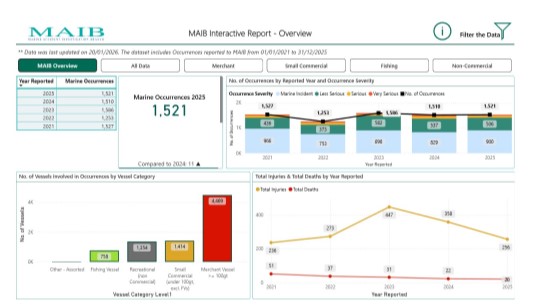
The UK Marine Accident Investigation Branch (MAIB) has published updated figures for 2025, offering a snapshot of safety trends across the maritime sector.
The UK Marine Accident Investigation Branch (MAIB) has published updated figures for 2025, offering a snapshot of safety trends across the maritime sector.
The data records a total of 1,521 marine occurrences during the year, a marginal increase on the 1,510 in 2024, but still below the 1,586 reported in 2023. While the overall picture suggests relative stability, the detail reveals persistent risks for seafarers and vessels alike.
Merchant vessels accounted for the majority of reported cases. Of the 1,521 occurrences logged in 2025, 880 involved merchant shipping. Within this category, 596 were classified as marine incidents, with a further 249 deemed less serious. More concerning were 30 serious incidents and five very serious cases, defined by MAIB as involving loss of life, vessel loss or major environmental damage.
In total, 907 vessels were involved in marine incidents during the year. One vessel sank and eight were abandoned. These events resulted in 111 crew injuries and two fatalities, a stark reminder that even incremental changes in annual figures represent real human consequences.
Large vessels continued to feature prominently. Ships of 3,000 gross tons or more were involved in 628 incidents. Mid-sized vessels between 500 and 2,999 GT accounted for 179 incidents, while smaller merchant vessels in the 100–499 GT range were involved in 50 incidents each.
The most common type of incident was damage or loss of equipment, with 376 cases reported. Injuries to personnel followed at 222, ahead of loss of control (81), collisions (67) and contact incidents (64). Although less frequent, groundings, fires, flooding and capsizing were identified as high-risk events due to their potential for catastrophic outcomes.
Injury data varied significantly by vessel type. Passenger ships recorded 100 injuries but no fatalities, the highest injury count across categories. Cargo ships reported fewer injuries, at 31, yet were the only merchant vessel type to record fatalities, with two deaths. Service ships recorded 29 injuries, inland waterway vessels nine, and recreational craft two, with no deaths reported.
The figures highlight the ongoing exposure to risk at sea, and the continued importance of safety culture, training and vigilance across all sectors of the maritime industry.
The ful data set is available here
Tags
More articles
MCA urged to issue new safety guidance for non‑SOLAS vessels after fatal 2023 pilot ladder accident
The Maritime and Coastguard Agency has been asked to issue new safety guidance urging non‑SOLAS vessels to carry an alternative means of recovering an unconscious person, following a recent Marine Accident Investigation Branch (MAIB) report into a fatal pilot transfer accident.