
- Topics
- Campaigning
- Careers
- Colleges
- Community
- Education and training
- Environment
- Equality
- Federation
- General secretary message
- Government
- Health and safety
- History
- Industrial
- International
- Law
- Members at work
- Nautilus news
- Nautilus partnerships
- Netherlands
- Open days
- Opinion
- Organising
- Podcasts from Nautilus
- Sponsored content
- Switzerland
- Technology
- Ukraine
- United Kingdom
- Welfare
Seafarers are still being 'sent into the lion’s den' without adequate training to tackle the problem of sexual assault and sexual harassment at sea, warn campaigners. Deborah McPherson and Sarah Robinson report
On 1 January 2026, a landmark global agreement came into force at the International Maritime Organization (IMO). The agreement requires seafarers to be equipped with 'knowledge and understanding of violence and harassment, including sexual harassment, bullying and sexual assault, and information on how to prevent and respond to incidents'.
This is an obligation on IMO member states, and it appears in a package of regulations that governs what maritime professionals are taught around the world: the Standards of Training, Certification and Watchkeeping (STCW) Code. In many ways, this is a major step forward for the maritime industry, which has long tolerated levels of shipboard bullying and harassment that would be unthinkable in most shorebased workplaces.
However, there are concerns that the agreement does not go far enough, and that regulators, flag states and employers have too much leeway to decide for themselves what form the training will take. This is particularly the case when it comes to the training that addresses sexual harassment and sexual assault.
'An industry-wide systemic problem'
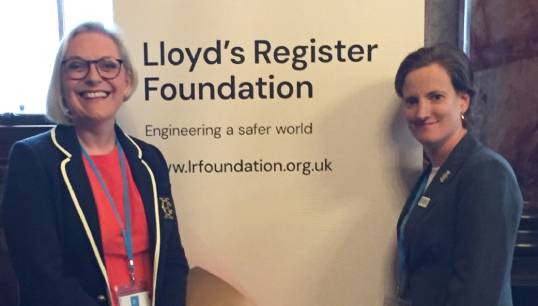
At an 18 May industry event to mark International Women in Maritime Day, safe workplace campaigners Emma Mark and Ann Pletschke threw down a clear challenge to regulators, flag states and employers: stop treating sexual harassment and sexual assault as a talking point and start treating it as a core safety obligation.
'This cannot be just another conversation,' said Mrs Mark. 'We have a plethora of reports and data to say that this is an industry-wide systemic problem that needs action.'
The pair highlighted the devastating impact of sexual harassment and sexual assault on seafarers' lives and stressing the need for comprehensive, accessible training to ensure safety and trust within the industry. And they did not believe the changes to the SCTW Code were sufficient to address the problem.
They said the blame for this lay at the door of IMO member states, which as part of an IMO working group endorsed the idea that practical implementation of the agreement should be left to individual flag states.
'Don’t restrict training to new cadets'
From looking at what has been done so far, it appears that – at least in the UK – the new training has been restricted to a small update to what officer cadets learn in the Personal Safety and Social Responsibilities (PSSR) module of their college training, and there has been little attempt to reach experienced seafarers.
'This is just not good enough,' argued Mrs Mark. She explained that new seafarers, equipped with fresh training on tackling sexual assault and sexual harassment and psychological safety, would be joining vessels where existing crew may never have had similar awareness or guidance.
'What I would like to see is that we mandate training for all seafarers on the prevention of sexual assault and sexual harassment at sea,' Mrs Mark continued. 'If we continue down the road of only providing training for new cadets, then we are essentially sending them into the lion's den.'
'How we can improve on the minimum standards'
Captain Pletschke pointed out that the STCW framework is a minimum standard, not a ceiling, and that flag states can go above that. Nothing prevents flag states such as the UK, via its enforcement body the Maritime & Coastguard Agency (MCA), from going further.
She noted that some administrations have already introduced mandatory training covering sexual assault, bullying and sexual harassment prevention and response, in addition to producing strong guidelines on how to report sexual assault at sea and clearly defining the processes vessels should follow. By contrast, similar guidance is still lacking in countries such as the UK, the Netherlands and Switzerland.
To close this gap in the UK, Capt Pletschke proposed a 'bridging solution' for existing seafarers: a short (60-90 minute), free online computer-based training module on sexual assault and harassment prevention and psychological safety.
This training should be free of charge, she stressed, in recognition that many British seafarers already pay for their own STCW renewals. It should also be linked to a certificate of competency renewal for officers, with strong encouragement for ratings. It could also be implemented over a transition period to 2026, avoiding the need to re-do full PSSR courses.
'For the sake of a one hour, 90-minute e-learning module, it's not going to be a huge burden on the taxpayer,' Captain Pletschke argued. 'If a major flag state such as the UK's MCA leads the way, it could model best practice and offer the module to other administrations, helping raise standards internationally.'
'It's time for more respect for all of us'
Both campaigners emphasised that the call for change rests on a solid and growing evidence base.
Mrs Mark cited the Sailors' Society cadet report (2025–2026) which found that a key barrier to sexual harassment reporting is 'trust in the outcome' – not just whether a process exists, but whether seafarers believe it will deliver a fair response.
Mrs Mark also referenced a recent Diversity Study Group survey of over 6,000 seafarers, where 2% reported experiencing sexual assault or sexual harassment at sea, and she noted that, of those, 64% were male – which shows that safety at sea is not just a female seafarer issue.
Captain Pletschke pointed to Nautilus-backed research by the University of Winchester in collaboration with the charity Safer Waves and Devon and Cornwall Police, highlighting the prevalence of sexual crimes witnessed at sea and the obstacles to reporting.
She continued: 'Ships can become "jurisdictional black holes", where perpetrators understand that enforcement is weak, victims are isolated, and job security concerns make it harder to speak up.'
Amid the policy and data, Mrs Mark insisted that the human cost must remain central: 'Seafarers are not fodder, and with the crewing crisis that we are currently facing, we have to consider how best to retain the crews we have as we rely on them so much in our everyday lives. It is important to remember that every seafarer is someone's son or daughter, and they should be treated with respect.'

What does the MCA say?
The UK Maritime & Coastguard Agency (MCA) has issued an M-notice setting out its current position on IMO Resolution MSC.560(108) which introduces new content on preventing violence and harassment to the Personal Safety and Social Responsibilities (PSSR) course (STCW Code, Table A-VI/1-4), from 1 January 2026.
The notice MIN 729 states that, in the UK, the new requirements apply only to seafarers undertaking Personal Safety and Social Responsibilities (PSSR) training on or after 1 January 2026. Existing seafarers who already hold a valid PSSR certificate are not required to complete additional training to meet these amendments.
The MCA’s current view is that no changes are required for existing seafarers, so those who undertook PSSR before 1 January 2026 do not need to redo PSSR training. There is no need for PSSR certificates issued by an MCA-approved training provider to be reissued; these certificates remain valid indefinitely.
A UK-issued Certificate of Competency (CoC), Able Seafarer Certificate of Proficiency (CoP), and Watch Rating CoP continue to serve as proof of PSSR, as per sections 5.2 and 5.3 of MIN 643.
However, the MCA does strongly recommend that all companies provide training and guidance for their seafarers in line with MSC.560(108), to promote good working practices and ensure a safe and supportive working environment.
Existing seafarers may need to demonstrate compliance with MSC.560(108), and in some cases may be asked to re-take PSSR if their company or the administration of the vessel’s flag state adopts a different approach.
- To read the full M-notice, go to www.gov.uk and search for MIN 279
Image: Getty Images
Tell your Union what you think
As a Nautilus member, you have a say on how we campaign on tackling sexual harassment in the maritime workplace. As the major review of the STCW Code continues, what do you want to happen at the International Maritime Organization? What about national administrations and maritime colleges in the UK, Netherlands and Switzerland?
We have an influence on all these decision-making bodies, and our representatives take their lead from members like you. To have your say, you can:
- attend a Nautilus General Meeting or national branch conference
- attend our Professional & Technical Forum and Equality & Diversity Forum
- email your thoughts to telegraph@nautilusint.org, women@nautilusint.org or protech@nautilusint.org
Get help:
If you are experiencing bullying or harassment at work, you can access support from your Nautilus industrial organiser. If you are a female member wishing to speak to our designated women's lead, please contact the switchboard and ask for Rachel Lynch or email women@nautilusint.org. Remember that sexual assault is a crime both at sea and ashore, and if you need to make a report, the charity Safer Waves can help – see www.saferwaves.org
Tags